Clear Aligners in the UK: How They Work and What to Expect
Clear aligners have become one of the most familiar names in adult orthodontics, yet most people who ask about them know the term far better than what actually happens once treatment starts. They are removable, custom-made, transparent trays that straighten teeth in a planned sequence. From our clinic on New Bond Street, we see this gap between name recognition and understanding every week.
Below, we cover how clear aligners actually work, how long treatment realistically takes, what they cost in the UK, how they compare with fixed braces, and the cases where they are not the right choice.
Clear Aligners Explained
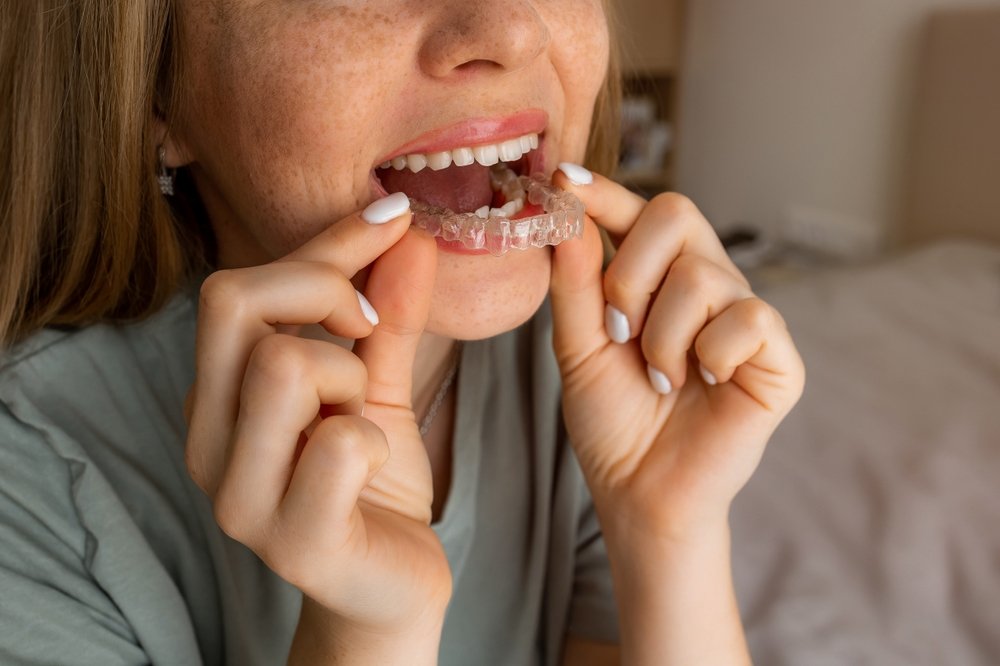
Clear aligners are removable, custom-made, transparent plastic trays that gradually move teeth into a planned position. Each tray is worn for 20 to 22 hours a day and swapped for the next one in the series every 1 to 2 weeks, so the teeth move in small stages rather than all at once.
They come out for eating, for drinking anything other than water, and for brushing: no food restrictions, no change in how you clean your teeth, and an appliance that is nearly invisible across a meeting table.
How Clear Aligners Work
Clear aligners move teeth using steady, gentle pressure transmitted through the periodontal ligament, the tissue that attaches each tooth root to the surrounding bone. Under sustained light force, the bone around the root remodels, and the tooth migrates. Each tray is shaped slightly differently from where your teeth currently sit, so it asks specific teeth to move a small, planned amount.
Treatment starts with an intraoral scan, or impressions, where a scan is not practical. From that, we build a digital plan of every stage of movement, and the full tray series is manufactured to match. Most plans also involve bonding small tooth-coloured composite attachments to certain teeth. These give the aligner something to grip, which makes rotations and vertical movements possible; without them, a smooth tray would simply slide over a rounded tooth.
Patients usually report tightness or mild pressure for a day or two after changing to a new tray, and speech can feel slightly different for the first few days.
| One thing to understand about the digital plan: It is a prediction of tooth movement, not a fixed result. Teeth do not always track exactly as the software forecasts, which is why we review progress in person and refine or reissue part of the series when needed. |
How Long Clear Aligner Treatment Take
Most clear aligner cases run six to 18 months. Minor crowding limited to the front teeth can be finished in around six months, while significant movement, bite correction, or closing a gap left by a missing tooth takes longer, sometimes beyond two years. These are typical ranges based on case complexity, not a promise attached to any individual mouth.
The biggest single variable is wear time. Every plan is built on the assumption of 20 to 22 hours a day. Taking aligners out for long stretches means the teeth do not reach the position the next tray expects them to, and treatment extends. We normally review patients every six to 10 weeks to check that the teeth are tracking to plan.
| Quick tip: Keep your previous tray until the new one is seated and comfortable, and carry a proper case. Aligners wrapped in a napkin at lunch are the ones that end up in the bin. |
Clear Aligners vs Fixed Braces: How They Compare
Both appliances move teeth using the same biology. The differences are practical, and they matter more than most patients expect:
- Appearance: Aligners are close to invisible in normal conversation. Fixed braces are visible, although cosmetic braces with ceramic brackets are far less obvious than metal ones, and lingual braces are bonded behind the teeth, where they are not seen at all.
- Eating and cleaning: Aligners come out for meals, so there are no food restrictions, and brushing and flossing stay exactly as they are. Fixed braces mean avoiding hard and sticky foods and cleaning carefully around brackets and wires.
- What each can treat: Aligners handle a wide range of crowding, spacing, and alignment problems. Fixed appliances still have the edge on complex movements, severe rotations, and significant bite correction.
- Discipline: This is the real trade-off. Fixed braces keep working whether or not you are motivated, because they are attached to your teeth. Aligners only work if you wear them, so the result depends on you.
- Cost: Both sit in a similar private range, with the figure driven by how complex the case is, rather than which appliance is chosen.
Our specialist orthodontists will tell you plainly if your case would be better served by a fixed appliance. We would rather say that at the assessment than eighteen months into the wrong treatment.
Clear Aligners Cost in the UK
Across the UK market, clear aligner treatment generally ranges from around £1,500 for very limited movement to approximately £6,000 for comprehensive treatment. That is a market-wide range rather than our fee: in-person treatment supervised by a specialist sits towards the upper end, and remote or postal services at the bottom.
At Holford Partners Curaden Dental Clinic, Invisalign treatment starts from £4,000. Retention is an additional cost once the teeth are in position: £195 per arch for a removable retainer, £250 per arch for a fixed retainer, or £750 for a set of three Vivera retainers.
Our price list sets out current fees in full. The figure we quote depends on how much movement is needed and how many aligners the plan requires, which is why we scan before we price.
Remote and Postal Aligner Services
Remote aligner services are cheaper because no clinician examines you in person. Treatment is planned from photographs you take yourself and an impression kit you use at home, and the trays arrive by post.
The clinical concern is what that process cannot see. Moving teeth in a mouth with untreated decay or active gum disease poses real risk of harm, and neither condition is reliably visible in a photograph. Root position, the state of existing crowns or veneers, and how the back teeth meet all need a clinician, radiographs, and a physical examination. Both the British Orthodontic Society and the General Dental Council have raised concerns about direct-to-consumer orthodontics on these grounds.
Whichever route you choose, have a full dental examination first. Three questions are worth putting to any aligner provider: who is the named clinician responsible for your care, will they examine you in person, and what happens if a tooth does not track to plan.
Retainers Are Not Optional
Teeth drift after any orthodontic treatment, whether it was done with aligners or fixed braces. That is normal biology, not a treatment failure, and that is why retention is part of the plan rather than an add-on.
Most patients wear a removable retainer at night indefinitely, frequently alongside a thin fixed wire bonded behind the front teeth. Stopping retainer wear after a year or two is the most common reason patients later notice their teeth have moved. Retainers also wear out and need to be replaced periodically, so build that into your long-term budget. Clean them daily with cool water and a brush, never hot water, which distorts the plastic, and contact us promptly if one cracks or stops fitting.
Whether Clear Aligners Are Right for You
Clear aligners suit adults and older teenagers with mild to moderate crowding, spacing, or alignment problems who are willing to commit to 20 to 22 hours of daily wear. Mild bite issues and gaps left by a missing tooth can often be addressed, too, on a case-by-case basis after an examination.
They are less appropriate for complex bite problems, for patients who realistically will not keep to the wear time, and for anyone with untreated decay or gum disease, which we treat before any tooth movement begins. An assessment with our orthodontic team is the only reliable way to determine which appliance is right for your case. We have treated patients in Mayfair since 1863, combining British heritage with Swiss Curaden expertise in preventive dentistry, so the conversation starts with your oral health rather than the appliance.
Find Out Whether Clear Aligners Will Work for Your Teeth
An assessment with our orthodontic team at 73 New Bond Street includes a scan of your teeth, a clear explanation of which appliance suits your case, and a written cost before you commit to anything. Book a consultation online or call 020 7499 9806 to arrange a time on the first floor, 73 New Bond Street, Mayfair, London.