How Long Does Teeth Whitening Last?
Whitening performed by a dental professional typically lasts from 6 months to 3 years. How long teeth whitening lasts depends far less on the method you choose than on what you eat, drink, and do every day afterwards, which is why the range is so wide.
Nothing about teeth whitening is permanent: the gel lifts stain out of the tooth, and from the moment the course finishes, your teeth begin picking up new stain again. Dentist-supervised home whitening with custom-made trays tends to hold the longest, mainly because you keep the trays and can run a short top-up course when the shade starts to drift.
Over-the-counter kits generally fade faster, and there is a specific legal reason for that, which we set out further down this page.
Teeth Whitening Options
There are four realistic routes, and they are not interchangeable. Here is an honest assessment of what each one can and cannot do:
- Dentist-supervised home whitening with custom trays. A registered dentist takes impressions, makes trays that fit your teeth precisely, and supplies whitening gel for you to wear at home over an agreed period. The trays are yours to keep, which makes top-ups straightforward. This is usually the longest-lasting option.
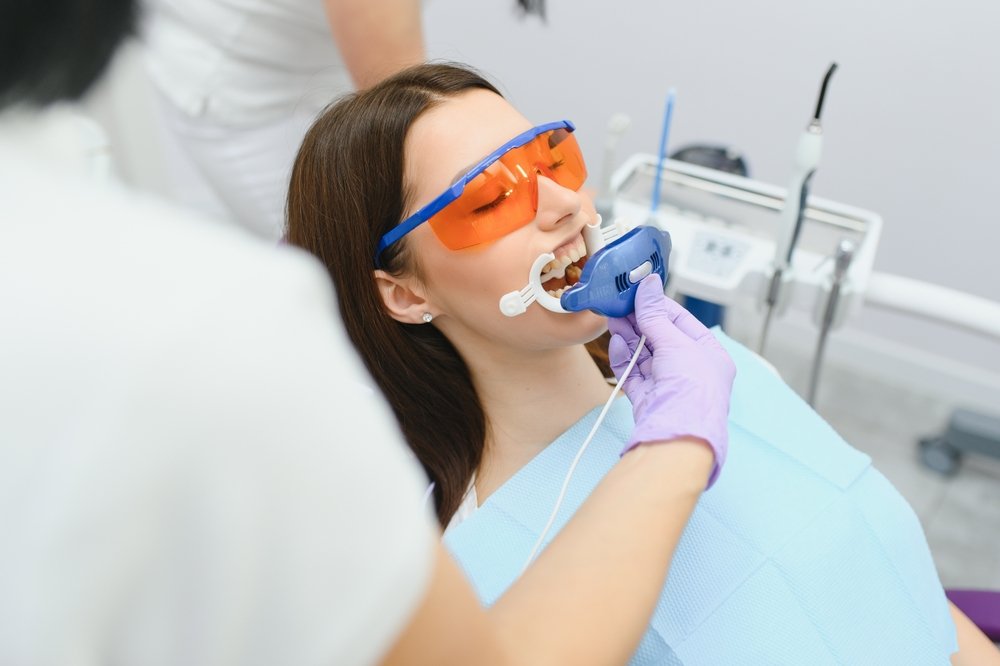
- Chairside whitening at the clinic. Carried out in a single supervised appointment, which suits people working to a deadline. Sometimes marketed as laser whitening, where a light is used alongside the gel, the longevity question is the same either way, because the result still depends on re-staining. It is often paired with home trays, so the result can be maintained rather than left to fade.
- Over-the-counter strips and kits. Limited by UK law in what they can contain, covered properly below.
- Whitening toothpaste. Works through mild abrasives and polishing agents that remove surface stains. It does not change the tooth’s underlying colour, so treat it as maintenance rather than whitening.
Worth knowing before you spend anything: A good deal of what people read as “yellow teeth” is extrinsic staining sitting on the enamel surface, not the natural shade of the tooth. A hygiene appointment removes that build-up, and some patients find it gives them the result they were actually after without any gel at all. It is also the sensible first step, because whitening works more evenly on clean teeth. |
Whitening Strips and Over-the-Counter Kits
Products sold directly to the public in the UK are limited to 0.1% hydrogen peroxide, or the equivalent released from carbamide peroxide. Products containing more than 0.1% and up to 6% may only be supplied through a dental professional, with the first use carried out or directly supervised by a dentist. That rule, set out by the General Dental Council, is the sole explanation for the gap in results.
In practice, a 0.1% product can shift surface-level discolouration and little more, and the change tends to be shorter-lived. Generic one-size trays are the other weakness: gel that is not held against the teeth ends up on the gums instead. Be wary of “non-peroxide” formulations marketed online as a way around the limit, and be more wary still of high-strength gels bought from abroad, where concentration and quality are unverified.
Teeth Whitening On Your Enamel
Whitening carried out by a GDC-registered dentist at concentrations permitted by UK law does not damage enamel. The gel breaks down stain molecules held inside the tooth structure; it does not strip or dissolve the enamel layer. The genuine side effects are temporary tooth sensitivity and gum irritation, both of which usually settle once the course ends.
Where real harm occurs is almost always outside the scope of regulated dentistry. Tooth whitening is a dental practice in the UK, so carrying it out without GDC registration is illegal. Beauty salons, shopping-centre kiosks, and mobile operators working without a registered dental professional are at risk.
A dental examination comes first for a reason. Whitening gel is applied to healthy teeth and gums, so untreated decay, gum disease, cracked fillings, or exposed root surfaces need attention beforehand. Custom trays matter for safety as much as for results, because they hold the gel where it belongs and keep it off the soft tissue.
Check your provider: Anyone whitening your teeth should appear on the GDC register, which is publicly searchable. You are entitled to ask which product is being used and at what concentration, and a registered practitioner will tell you without hesitation. |
Sensitivity After Whitening
Sensitivity during or after whitening is common and usually temporary, typically settling within a few days of finishing the course, though this varies between individuals. The mechanism is straightforward: the gel passes through the enamel into the dentine beneath, which can briefly make the nerve more reactive to temperature. Gum tenderness is a separate issue and usually comes from gel contact rather than from the teeth.
Several things help. Shortening each wear session, leaving a day between sessions, and using a desensitising toothpaste in the weeks beforehand all reduce the effect. The most useful step is to tell your dentist early so the regimen can be adjusted rather than abandoned halfway through.
We will not pretend it can be ruled out in advance. Patients with gum recession or exposed root surfaces are more prone to it. Sharp sensitivity, confined to one tooth, or that continues well beyond the end of treatment is worth having looked at, as it may point to something unrelated to the whitening.
Quick tip: Avoid very hot and very cold food and drink on the days you are wearing trays, and never double up on gel to make up for a missed session. |
How Long Does Teeth Whitening Last Before It Fades
The shade fades because teeth accumulate new stains, so your timeline is largely set by what passes over them each day. The usual culprits are coffee, tea, red wine, tobacco and vaping, curry and other strongly coloured sauces, dark berries, balsamic vinegar, and some fruit juices.
Habits that stretch the results are unglamorous but effective: Rinsing with water after staining drinks, using a straw for iced coffee, and keeping to regular hygiene visits so surface stains never build into a layer. Ageing works against you quietly too, since enamel thins over time and the naturally yellower dentine beneath shows through more. |
Top-ups are the practical answer. Patients who have custom trays can re-run a short course with fresh gel supplied by the practice, which is a clear advantage over a single-visit-only approach. We do not set a fixed top-up interval in advance; it is agreed with your dentist based on how your shade actually holds.
Which Teeth Cannot Be Whitened
Whitening gel only changes the colour of natural tooth structure. It will not lighten crowns, veneers, inlays, onlays, bridges, or existing white fillings, which keep the shade they were made in.
That makes sequencing important. Whiten first, let the shade settle, then match any new cosmetic or restorative work to it. Do it the other way round, and new composite bonding or porcelain veneers will look darker once the surrounding natural teeth lighten.
Whitening also does not treat white spots on enamel. Those are different problems with different solutions, and ICON white spot removal is the route worth discussing instead. Teeth darkened from the inside by intrinsic staining, for example, after trauma or root canal treatment, may not respond to external whitening in the same way and need individual assessment. Tetracycline staining and some developmental conditions respond slowly and unpredictably, which is the clearest argument for a consultation before you buy anything.
Whitening at Our Mayfair Clinic
We are Holford Partners Curaden Dental Clinic, first floor, 73 New Bond Street, Mayfair, London W1S 1RS. More than 120,000 patients have been treated at this practice since 1863, and we combine that British heritage with Swiss Curaden expertise and a preventive dentistry ethos, which is why we tend to start with the health of your teeth and gums rather than the shade chart.
Home whitening with bespoke trays starts at £480 and chairside whitening at £795; current prices are always listed on Our Prices, and you can read more about our whitening treatments before you book. A consultation covers a shade assessment, a check that your teeth and gums are healthy enough to whiten, a discussion of any history of sensitivity, and a conversation about which method genuinely suits you. We do not decide that before we have seen you, and professional teeth whitening is not the right answer for everyone who asks about it.
Find out which whitening method suits your teeth before you buy anything. A consultation at our New Bond Street clinic gives you an honest answer on how long teeth whitening is likely to last for you, rather than a figure borrowed from an average. Call 020 7499 9806 or book a consultation online.